Goods Triple Match: Sorting 3D
- 4.9
- Rating
- 5.00M
- Installs
- Free
- Price
 Analysis by App-foxy
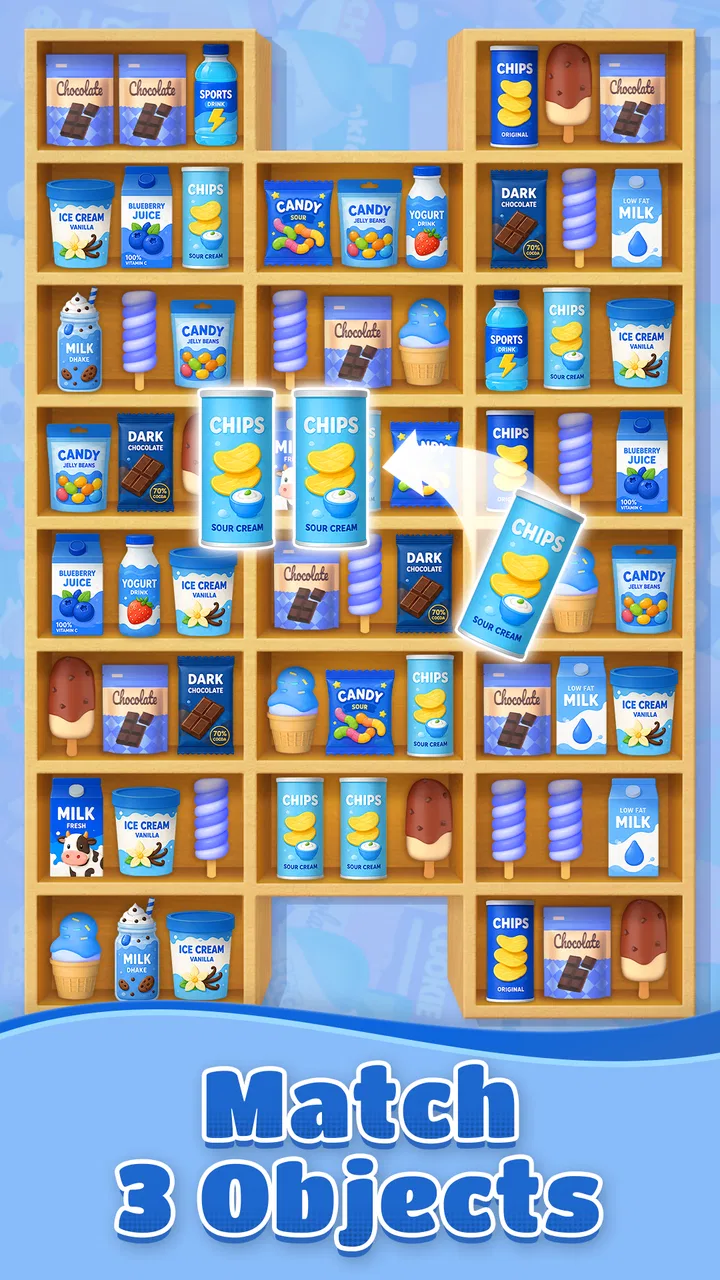
I picked up Goods Triple Match: Sorting 3D expecting a simple way to fill a few spare minutes, and that is exactly where it makes the strongest first impression. The game turns a crowded collection of three-dimensional products into a sorting puzzle: I look for three matching goods, place them together, and gradually clear the space. The idea is easy to understand almost immediately, which matters when I am playing between errands rather than settling in for a long gaming session.
It is a free puzzle game from Joymaster Puzzle Game Studio, aimed at Everyone, and it runs on Android 7.0 or later. Its store presence is already substantial, with an average rating of 4.9 from around 198 thousand ratings and more than 5 million installs. Those figures do not replace personal experience, but they do fit the game’s main appeal: it is approachable, visually direct, and built around quick decisions rather than a complicated ruleset.
Why the first few rounds are so easy to start
The central action is familiar if you have played match-three or sorting games, but the 3D presentation gives it a different feel. Instead of swapping gems on a flat board, I am scanning shelves or piles of everyday-looking objects and searching for a trio. The satisfaction comes from spotting a useful match in a busy scene, tapping the items in the right order, and watching that small section of clutter disappear.
You May Also Like

 Blood Strike: 2.5 Anniversary
Blood Strike’s Loadouts Turn Every Drop Into a Tactical Gamble
A close look at Blood Strike’s custom loadouts: how fast access to signature weapons reshapes its battle royale rhythm, rewards preparation, and narrows the gap between fights.

 Pandora - Music & Podcasts
Pandora’s Music Is Easy to Start, but Harder to Recover
Pandora’s strength is its low-effort path from a seed to a station. Its weak spot is how much confidence it asks you to place in connection, setup, and quiet recovery.

 8 Ball Pool
 Is Built on Rivalries, Rematches, and Routine
A close look at the rivalries, rematches, shared routines, and unanswered safety questions that turn a quick pool match into a persistent mobile community.

 Samsung Music
’s Quiet Strength Is Playing What You Already Own
Its reach comes less from spectacle than from dependable access to a personal library. That simplicity is both the app’s strongest retention engine and its ceiling.

 AccuWeather: Weather Radar
AccuWeather Review: A Quick, Clear Forecast for Everyday Decisions
For everyday plans, the best forecast is the one you can understand quickly. AccuWeather makes rain timing, radar, and local conditions easy to act on, with a few trade-offs.

 Hill Climb Racing
Why Hill Climb Racing Still Turns Crashes Into One More Run
A tiny car, a bumpy hill and one more upgrade: Hill Climb Racing keeps resurfacing because its simple chaos makes every near-miss feel personal.
More From Our News Desk



That visual search is the real hook. The game does not ask me to read instructions for long or memorize a complicated system before I can enjoy it. I can understand the objective while holding my phone in one hand, which makes it a natural choice for a short break. The best moments are not dramatic; they are the small bursts of relief when a difficult-looking area suddenly opens because I found the third item I had overlooked.
I also like that the puzzle has a physical, almost tidying-up quality. Sorting objects into groups feels more concrete than simply matching colored shapes. Even when the underlying action is simple, the 3D goods make each board easier to read as a little space that needs organizing. That gives the game more personality than a completely abstract tile grid.
There is a trade-off, though. A three-dimensional scene can be more attractive than a flat board, but it can also make recognition slower. When several objects have similar colors or are partly hidden by others, I spend more time checking the layout instead of solving it. Players who prefer clean, instantly readable puzzle boards may find this presentation less efficient than a conventional match-three game.
A rhythm designed for spare minutes
In my experience, the strongest use case is the awkward gap in a normal day: waiting for an appointment, taking a short break, or sitting on public transport with only a little attention available. The game gives me a clear task without demanding a long commitment. I can begin by scanning the visible goods, make a few matches, and stop when the moment is over.
That short-session quality comes from the narrow mental loop. I identify a trio, decide whether taking it now will expose something useful, and then repeat the process. There is enough decision-making to keep my attention engaged, but not so much that I need to prepare mentally before playing. It works particularly well when I want a puzzle rather than a passive distraction.
Still, “quick to start” does not always mean “quick to finish.” A board can become more demanding once the obvious groups are gone. I may begin with a relaxed series of taps and then reach a point where every move affects the remaining space. That change is welcome when I want a little challenge, but it can be inconvenient if I only have a few seconds before returning to something else.
My practical advice is to treat it as a game of flexible stopping points rather than assuming every visit will end neatly. If I know I might be interrupted, I avoid starting when I am already rushing. The early part of a round is forgiving, while a later crowded position deserves more attention. That simple habit makes the game feel less frustrating during real-world play.
How well it handles interruptions
This is where the game’s basic design helps. Because the objective is always visible through the objects themselves, I do not need to remember a story, a quest, or a chain of instructions after putting the phone down. When I return, I can usually understand the situation by looking at the board: which goods are grouped, which spaces are blocked, and which matching items are still available.
That makes it more interruption-friendly than puzzle games that rely on maintaining a long sequence in my head. I can answer a message or put the phone away briefly and come back without feeling completely lost. The visual state carries much of the memory burden for me.
There is an important exception. If I leave during a crowded arrangement, I may forget the promising match I had been planning. The game remains understandable, but I lose the mental thread of my next move. Before pausing, I find it useful to note the most obvious unfinished trio or make a safe move that leaves the board easier to read. This is a small technique, but it prevents the return experience from becoming a fresh puzzle-solving session.
It also suits players who dislike games that punish a missed daily routine. I can open it when I have time and ignore it when I do not. The appeal is immediate rather than dependent on maintaining a long-term schedule. For someone looking for a structured campaign or a deep progression system, that same simplicity may feel limited.
Where the pleasure starts to repeat
The first attraction is discovery: I am learning how the 3D goods are arranged and enjoying the act of clearing them. After several sessions, the pleasure shifts toward efficiency. I start scanning for groups before tapping, thinking about which match will reveal the most useful space, and avoiding moves that leave too many similar objects competing for attention.
That shift gives the game some replay value. I am not only asking, “Can I find three?” I am also asking, “Which three should I take first?” A visible trio may be safe, but another choice might open the middle of the arrangement and make later matches easier. The game becomes more satisfying when I stop treating every match as equally valuable.
One of the less obvious skills is managing visual clutter. I try to clear objects that are obstructing several possible groups, even when they are not the most exciting match on the screen. This is a useful approach for difficult layouts because it improves visibility rather than merely reducing the item count. In other words, the best move is sometimes the one that makes the next decision easier.
Another helpful habit is to scan in a consistent pattern. I look across the front layer first, then check partially hidden areas, and only afterward commit to a sequence. Random tapping feels fast at the beginning, but it can create a messy mental picture when the board becomes busy. A deliberate scan makes the game calmer and reduces the chance that I overlook the third item of a group.
The limitation is that this kind of replay value is mostly self-directed. The basic matching idea remains the same, so players who need constant new mechanics, a strong narrative, or a competitive ladder may lose interest. I can enjoy improving my choices, but I would not describe the game as a deep strategy title. It is a light sorting puzzle whose replay appeal depends on how much I enjoy refining a familiar routine.
Free to begin, with a point to consider
The game is free to download and play, which makes it easy to test without committing money at the start. That is appropriate for its casual format: I can see within a short time whether the object-matching loop suits me. The age rating of Everyone also reinforces its accessible presentation, although adults who want a more demanding puzzle experience may find the tone and mechanics intentionally light.
There are in-app purchases ranging from $1.99 to $99.99 per item. That range is worth noticing before playing for a long time. A free entry point is convenient, but optional spending can become part of the experience for players who want to move through obstacles more comfortably or use available assistance. I recommend deciding in advance whether I am treating the game as a no-cost time filler, because that boundary is easier to keep before I become invested in a difficult board.
For younger players, the Everyone rating makes the content broadly approachable, but I would still use the usual device-level purchase protections. The important point is not that spending is required; it is that the game includes paid items, so casual play and unrestricted purchasing should not be treated as the same thing.
The current version is 1.2.7, and the game was released on February 28, 2024. Those details are useful when checking compatibility or deciding whether the title is recent enough for your expectations, but they do not change my main assessment: the experience lives or dies by how much you enjoy sorting visual groups repeatedly.
Who will enjoy this more than the usual alternatives
I would recommend it to someone who likes match-three games but wants more spatial searching and less emphasis on swapping pieces. Traditional match-three puzzles usually present a tidy grid where the possible moves are easy to compare. This game is messier and more tactile. It asks me to find objects in a scene, so the challenge comes partly from observation and organization rather than only from planning combinations.
It is also a better fit than a word puzzle when I want something that does not require language. There is no need to think of answers, interpret clues, or maintain a vocabulary flow. The visual goods communicate the task directly. That makes it a comfortable option for a quick mental reset, especially when I am tired and do not want a reading-heavy game.
On the other hand, a classic match-three title is probably better for players who want rapid reactions, chain reactions, or a highly polished board with minimal visual ambiguity. A hidden-object game may be preferable if the search itself is the main attraction and matching feels secondary. A serious logic puzzle is the better choice for anyone seeking a carefully engineered challenge where every move has a more formal consequence.
The game sits between those alternatives. It is more active than a simple idle pastime, less demanding than a dedicated logic game, and more visually cluttered than a standard tile matcher. That middle position is its strength for casual players, but also the reason it may not satisfy specialists in any one puzzle style.
Small techniques that improve a short session
My first tip is to avoid tapping the first trio I see automatically. I check whether removing it will expose another item or leave a useful area open. This takes only a moment, yet it changes the game from simple recognition into light planning. I do not need to calculate the entire board; I only need to compare the immediate benefit of a few possible matches.
My second tip is to prioritize visibility when the layout becomes crowded. A match that clears a central obstruction can be more valuable than one that merely removes three easy goods at the edge. This is especially useful when I am playing in a short session and want to reduce the number of decisions waiting for me when I return.
My third tip is to pause after a clean match rather than tapping continuously. The animation and changing arrangement can make it tempting to continue on instinct, but a brief scan after each clear helps me notice newly exposed objects. That rhythm also makes the game more interruption-tolerant because I am less likely to leave the board halfway through an unexamined sequence.
Finally, I keep my expectations realistic about replay. The game is enjoyable when I want a repeatable sorting ritual, not when I need a constant stream of surprises. If I am using it as a five-minute reset, the repetition feels soothing. If I play for a long stretch and expect every round to introduce a new idea, the familiar structure becomes more noticeable.
My casual verdict after living with the loop
Goods Triple Match: Sorting 3D succeeds because it gets to the point quickly. I can understand the objective, enjoy the first match, and leave without carrying a complicated system in my head. The three-dimensional goods give the familiar matching formula a more tangible identity, while the sorting focus creates small decisions that reward looking before tapping.
Its best quality is not depth but convenience. It works in the gaps of a normal day, and it remains readable when I return after an interruption. I especially appreciate that the game can be played as a relaxed visual tidy-up or approached with more care by planning around visibility and space. That flexibility gives the simple formula more life than the store summary alone suggests.
My reservations are equally clear. The visual clutter can slow recognition, the core action repeats, and players who want a substantial campaign or advanced strategy will probably outgrow it. The presence of in-app purchases also means I would keep spending controls in mind, particularly on a shared device. None of those issues ruins the experience, but they define who should choose it.
My recommendation is straightforward: try it if you want a free, low-commitment puzzle for short breaks and enjoy organizing colorful 3D objects. Skip it if you need constant novelty, competitive pressure, or the clean precision of a traditional logic board. For the right player, it is a pleasant little routine—easy to enter, easy to pause, and just thoughtful enough to make a few spare minutes feel usefully occupied.
FAQs for Goods Triple Match: Sorting 3D
01What is Goods Triple Match: Sorting 3D?
Goods Triple Match: Sorting 3D is a casual puzzle game focused on organizing colorful products and matching three identical items. You sort objects across shelves, trays, or display areas and clear sets before running out of space or moves. The gameplay is simple to understand, but later levels introduce more clutter, limited room, and time or move pressure.
02How do you play Goods Triple Match: Sorting 3D?
To play, tap or move matching products into the available slots and create groups of three identical items. Clearing a complete trio removes it from the board and makes room for additional goods. Careful planning is important because placing unrelated objects can fill the tray quickly. Players should inspect hidden items and prioritize matches that unlock useful areas.
03Is Goods Triple Match: Sorting 3D free to download and play?
Goods Triple Match: Sorting 3D can generally be downloaded for free on supported Android or iOS devices, although the game may include optional in-app purchases. These purchases can provide coins, boosters, extra chances, or other conveniences, but they are not necessarily required to enjoy the main puzzle experience. Advertising may also appear between levels or after certain actions.
04Does Goods Triple Match: Sorting 3D require an internet connection?
The basic matching and sorting levels may be playable without a constant internet connection, which makes the game suitable for short sessions while traveling or when mobile data is unavailable. However, some features can depend on connectivity, including advertisements, purchases, cloud synchronization, events, rewards, or updates. Availability may vary according to the device version and the developer’s current implementation.
05Is Goods Triple Match: Sorting 3D suitable for children and casual players?
Goods Triple Match: Sorting 3D is easy for casual players to learn because it uses familiar tap-and-match mechanics rather than complicated controls. Its colorful 3D presentation can also appeal to younger audiences, but parents should review the current age rating, advertising, and in-app purchase options before allowing children to play. Difficulty and pacing can become more demanding in advanced stages.
Pros
- Relaxing match-3 gameplay suitable for short or long sessions.
- Bright 3D objects make items easy to recognize and select.
- Gradually increasing difficulty keeps the sorting challenge engaging.
- Simple controls are accessible for players of different ages.
- Offline play makes it convenient for travel or low-connectivity areas.
Cons
- Frequent ads may interrupt the flow between levels.
- Later stages can feel repetitive once familiar item sets return.
- Some levels may rely heavily on boosters to progress comfortably.
- Small objects can be harder to tap accurately on compact screens.
- Limited strategic variety compared with deeper puzzle games.

Goods Triple Match: Sorting 3D
Gallery